
Washington County Court Dockets
A docket is the court's running event list for a case. It may show the case number, court, judge, parties, filing dates, hearing dates, motions, orders, pleas, continuances, dispositions, and scheduled appearances. In Washington County, docket access depends on the court that owns the file. Superior Court, State Court, and Juvenile Court records route through the Clerk of Superior Court, while Magistrate and Probate matters use their own court offices.
Dockets are useful when a person needs to check whether a case is active, whether a hearing has been set, whether an order was entered, or whether a disposition has been recorded. They are also limited. A docket line may say that a motion was filed without showing the full motion. A calendar may show a hearing date without showing the pleading that caused it. For the full file, the requester usually needs to contact the court clerk and ask for copies.
- Docket
- A chronological list of court events and filings.
- Calendar
- A schedule of cases set for hearing or trial.
- Disposition
- The court's recorded outcome for a case or charge.
- Continuance
- A postponed court date.
Find Washington County Dockets
Washington County does not provide a single free countywide docket search on its official court pages. The practical docket path begins with the court type. Superior Court dockets can involve felony, divorce, custody, protective-order, land-title, habeas, name-change, adoption, and major civil case events. State Court dockets cover misdemeanors, traffic, and civil matters not reserved to Superior Court. Magistrate dockets can cover claims, dispossessories, warrants, first appearances, and commitment hearings. Probate dockets cover estates, guardianships, marriage-license related matters, firearms-license matters, and mental-health orders.
- Identify the court from the case type, citation, warrant number, or prior notice.
- Check the county court page for calendars, payment rules, and contact instructions.
- Use the Clerk of Superior Court for Superior, State, and Juvenile docket questions.
- Call Magistrate Court for warrants, first appearances, claims, dispossessories, and preliminary matters.
- Call Probate Court for probate, guardianship, marriage, and firearms-license docket questions.
- Request copies from the correct office if a docket entry points to a filing, order, judgment, or disposition.
The Eighth Judicial Administrative District Middle Circuit page lists Middle Judicial Circuit judges and cautions that calendars and assignments can depend on circuit scheduling. It is a useful circuit-level reference for Superior and Juvenile Court context.
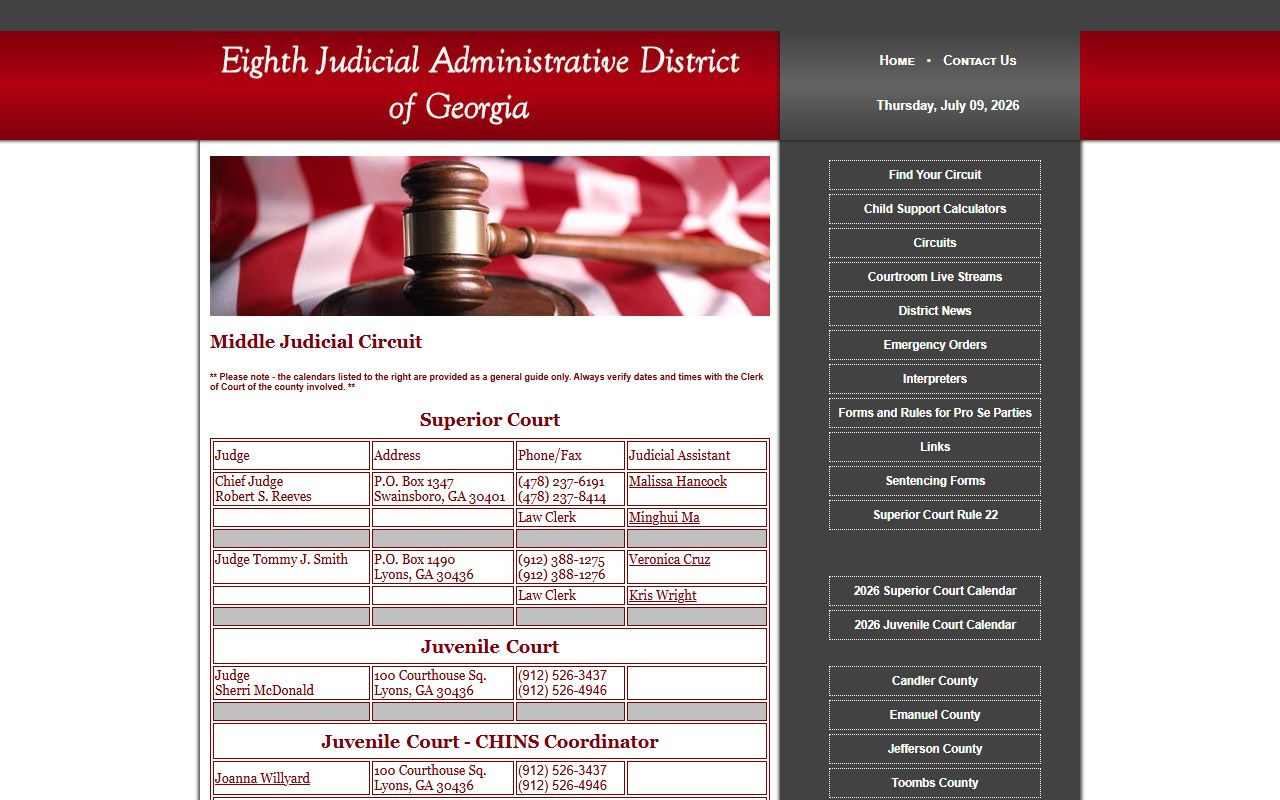
Because Washington County belongs to the Middle Judicial Circuit, circuit judge assignments and court sessions can matter when checking a Superior Court docket date.
Washington County Docket Entries
The research did not locate a public Washington County case-detail page that exposed a full docket sample without an account or selected case. A realistic Washington County docket inventory should therefore be treated as a clerk-held record field list, not as a promise that all fields are visible in a public online search. The fields below reflect the kinds of docket data normally found in court files and the Washington County research inventory.
| Field | What It Shows |
|---|---|
| Case Number | The identifier used by the court and clerk to locate the file. |
| Court | Superior, State, Juvenile, Magistrate, Probate, or municipal court. |
| Entry Date | The date a filing, hearing, order, or other event was recorded. |
| Event Type | A motion, order, plea, calendar call, hearing, trial, judgment, or disposition entry. |
| Party or Attorney | The person, office, or lawyer associated with a filing or hearing. |
| Judge | The judge assigned to the case or event when listed. |
| Disposition | The outcome of a charge, claim, petition, or case. |
| Copy Status | Whether the user needs a plain copy or certified copy from the clerk. |
Washington County Court Calendar Sources
Court calendars in Washington County are tied to court operations. Superior Court is in session at 10 a.m. on the first, third, and fourth Thursdays, and trial terms are listed for the first Monday of March, June, and December and the second Monday of September. State Court trials are normally held in January, May, and August at 9 a.m., and the county page lists a 2025 monthly calendar. Magistrate Court usually holds civil and criminal matters on Mondays and Wednesdays with 10 a.m. and 2 p.m. blocks. Juvenile Court sessions for Washington County are listed at 10 a.m. on the second and fourth Wednesday.
| Court | Docket or Calendar Use | Main Contact |
|---|---|---|
| Superior Court | Felony, divorce, custody, protective order, land-title, habeas, adoption, and civil calendars. | Clerk of Superior Court, 478-552-3186 |
| State Court | Misdemeanor, traffic, and civil calendars not reserved to Superior Court. | Clerk of Superior Court, 478-552-3186 |
| Magistrate Court | Claims, dispossessories, garnishments, warrants, first appearances, and commitment hearings. | Magistrate Court, 478-552-3591 |
| Probate Court | Estate, guardianship, marriage, firearms-license, and mental-health matters. | Probate Court, 478-552-3304 |
| Juvenile Court | CHINS, dependency, delinquency, juvenile traffic, truancy, and related matters. | Clerk or Deputy Clerk Santina Pierce |
Note: A calendar date is not a guarantee that a hearing will proceed, because courts can continue, reschedule, or resolve matters before the listed date.
Dockets vs Washington County Records
A Washington County docket gives the case timeline. The full case record gives the substance behind that timeline. For example, a criminal docket may show arraignment, motions, plea, verdict, and sentencing events, while the full criminal court record may include the accusation or indictment, orders, plea paperwork, probation terms, restitution, and sentencing documents. A civil docket may list a complaint and judgment, while the full file contains the complaint, answer, motions, notices, orders, and final judgment.
| Docket | Full Case Record | |
|---|---|---|
| Format | List of dated events and filings. | Documents, orders, pleadings, judgments, and certified copies. |
| Main Use | Track progress, court dates, and outcomes. | Review the legal papers or prove an official result. |
| Access Path | Court calendar, clerk status check, or docket request. | Copy request through the court office that keeps the file. |
| Limits | May not show the text of each document. | May include restricted, sealed, or redacted material. |
For all case-file access paths, use the broader Washington County court records process and then narrow the request to docket entries, orders, or certified copies.
Read Washington County Dockets
Docket entries use court terms that can be easy to misread. A filing date is not always the event date. A charge listed in a criminal docket is not the same as a conviction. A bench warrant entry may reflect a failure to appear after a case has opened, while an arrest warrant may come from Magistrate Court before full prosecution. A disposition line may close one charge while other counts remain open.
For Washington County criminal matters, the court level matters. Felony records move through Superior Court after prosecution begins. State Court handles misdemeanors and traffic violations. Magistrate Court may appear early in the timeline for first appearances, arrest warrants, search warrants, and commitment hearings. Juvenile dockets do not work like adult public dockets because juvenile dependency and delinquency records are restricted.
When the case type is unclear, use the notice, citation, warrant number, or charge description to narrow the court before calling. A traffic citation with a county State Court reference is different from a Sandersville municipal citation. A felony warrant number shown on the jail roster may lead to a Superior Court file after prosecution begins. A dispossessory or small claim will usually point to Magistrate Court. A guardianship, estate, or mental-health matter belongs with Probate Court and may not have the same public docket access as an ordinary civil file.
| Question | Likely Starting Point |
|---|---|
| Felony, divorce, custody, protective order, or major civil docket | Clerk of Superior Court |
| Misdemeanor, county traffic, or State Court civil date | Clerk of Superior Court |
| Warrant, first appearance, small claim, garnishment, or dispossessory | Magistrate Court |
| Estate, guardianship, marriage, firearms license, or mental-health matter | Probate Court |
| City traffic or ordinance matter | Municipal court or city payment office |
Georgia's access rules also shape what a docket can show. The Georgia Open Records Act and Uniform Superior Court Rule 21 favor access, but records can be limited by statute, court order, sealed status, juvenile law, adoption privacy, mental-health confidentiality, or personal-identifier redaction. When an entry looks incomplete, the right next step is usually a clerk call, not an assumption that the record does not exist.